I designed an AI-Powered Smart Search feature that helps 200,000 staff at a restaurant chain get accurate procedural answers in seconds.
My role covered
How do I safely thaw nuggets?
How do I handle a fake gift card?
What do I use to sanitize the crisper?
Questions like these come up in the moment and need a fast, accurate and easily-digestible answer. A slow or wrong answer has real costs, from reduced quality and speed for customers to actual food safety issues. If the answer takes too long to find, staff can fall behind or guess at the answer instead.
(Earlier, I'd launched a findability audit that had already resulted in a few shipped quick wins. The gap that remained is what the team chose to close with AI.)
The business goal was simple: increase adherence to standards by making it much easier for staff to quickly get accurate answers.
I designed the interaction as well as the AI instructions and guardrails to produce helpful and accurate answers.
The development team had picked Google's AI Overview as the baseline. I helped them figure out what to borrow and what to skip to fit our context.
For example, unlike Google, our library often has a single procedure that the answer is pulled from, so there's rarely a need to reveal multiple sources. I modified the system prompt and search behavior to emphasize the single source of truth and suppress noise, while accommodating edge cases where the answer does pull from - and needs to provide access to - multiple procedures.
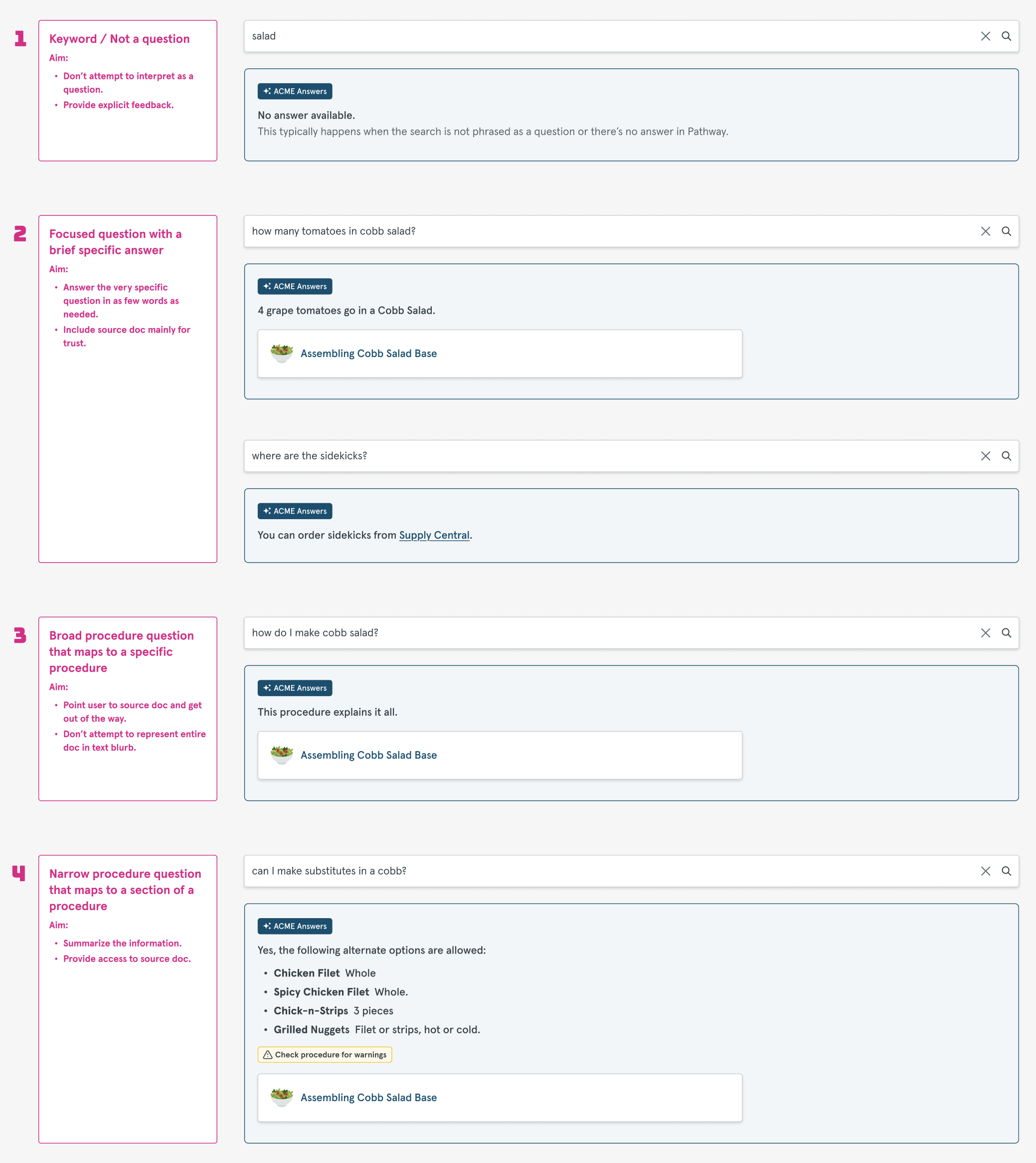
I mapped out the kinds of queries people actually send based on the search log. Then I defined what should happen in each case.
| Query type | Example | Shape of output |
|---|---|---|
| Narrow procedural question that maps to a section in a procedure | "How do I box nuggets?" "How many pickles on a deluxe burger?" | Give a short answer with a deep link to the exact section in the procedure |
| Broad procedural question that maps to a whole procedure | "How do I run the closing cleaning?" | Promote that procedure (with its images, tables, etc.) instead of trying to summarize it |
| Keyword or category search, not a question | "nuggets" | Suppress the AI answer; show regular search results only |
Form follows intent.
In a high-stakes setting, a confident wrong answer is worse than no answer, so I designed fallbacks.
| Case | Example | Impact on output |
|---|---|---|
| Low confidence | (AI can't produce a reliable answer) | Show dedicated message instead of an answer; explain why this can happen and what to do next; keep regular search results available * |
| Unexpected error | (AI can't produce an answer due to a technical issue) | Show dedicated message instead of an answer; keep regular search results available |
* To help the user get more value when the initial request is ambiguous and the answer confidence low, I also pushed for a conversational approach in which the AI can ask clarifying questions.
Every choice had to pass one test: can someone read this mid-shift and trust it?
To ensure quality answers - concise, accurate and easy to digest - I tested the proof of concept on real procedures and tweaked settings behind the scenes:
I also worked with Product to get SMEs to stress test it using the feedback mechanism I designed.
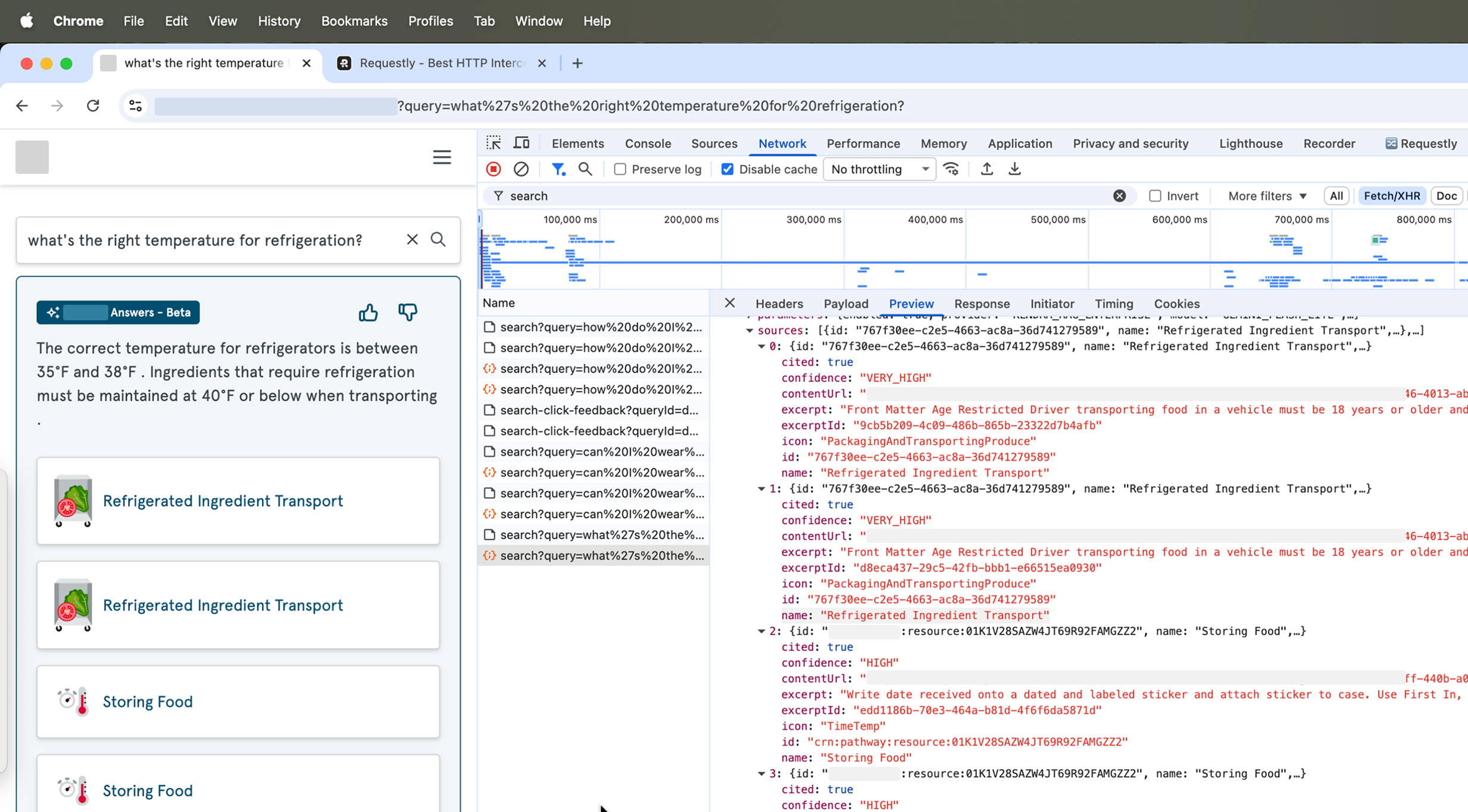
Hands-on with real data and developer tools. This let me inspect the AI inputs and adjust the system prompt to ensure the best results for users.
There was no clear playbook. My work bounced between setting direction and responding to what was being built. Both were valuable, as direction without testing is just guesswork, and testing without direction is tuning toward nothing.
Partnering with engineering allowed me to see how the AI behaved on real content, and perform real-time experiments to tune both logic and UI towards a better user experience and outcomes.
I worked with Product on how to measure success in business terms, including
I discussed several further improvements with the team. Expanding the shared view of the solution space helped engineering plan around it, even if we chose to defer in the short term.